
Frequently Asked Questions
FAQ
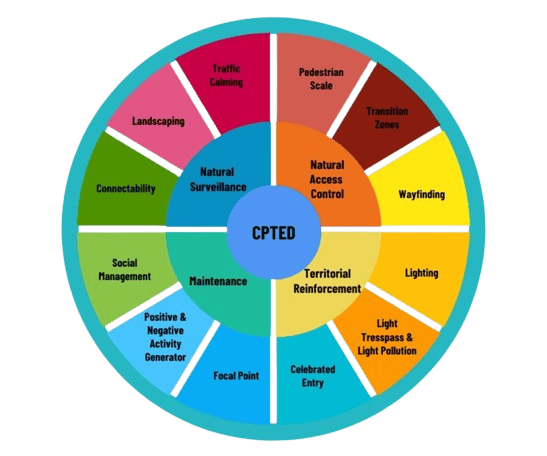
The National Institute of Crime Prevention created this infographic as an ideal representation that demonstrates the strategies and principles of Crime Prevention Through Environmental Design
Crime Prevention Through Environmental Design (CPTED) is a multidisciplinary strategy for deterring criminal behavior and protecting a community. It is grounded in the idea that the environment can impact response to crime and social control. CPTED principles aim to create environments that are more conducive to safety and security, reducing the opportunities for crime to occur.
CPTED Principles
CPTED (Crime Prevention Through Environmental Design) is a strategy that uses environmental design to deter crime. It focuses on four key principles:
- Natural Surveillance: Creating spaces where people can easily see what's happening, such as through good lighting and clear sightlines.
- Territorial Reinforcement: Designing spaces that give residents a sense of ownership and control, like well-defined property lines or community gardens.
- Access Control: Limiting access to buildings and areas through controlled entrances and exits.
- Maintenance and Order: Keeping spaces clean, well-maintained, and free of vandalism to create a positive image.
These principles can be applied to various locations, including neighborhoods, commercial areas, and public spaces. By incorporating CPTED into design and planning, we can create safer and more welcoming environments.
A CTPED Assessment will identify the positive areas of the properties’ current environment and areas that need improvement. Areas needing improvement, including safety and security vulnerabilities, will be identified and options to consider for corrective actions will be provided to help the owner or principal operator make informed decisions on how to make the environment safer and, for multifamily residential properties, get them in compliance with FS 768.0706 (HB837).
Florida Statute 768.0706, also known as House Bill 837, addresses safety and security measures for multifamily residential properties. This statute was enacted to provide property owners with enhanced protections against frivolous lawsuits related to criminal activities occurring on their premises. Here are the key points of the statute:
- Presumption Against Liability: The law establishes a rebuttable presumption that property owners are not liable for criminal acts occurring on their property if they have implemented certain security measures.
- Required Security Measures: To qualify for this presumption, property owners must have:
- A security camera system at points of entry and exit which records, and maintains as retrievable for at least 30 days, video footage to assist in offender identification and apprehension.
- A lighted parking lot illuminated at an intensity of at least an average of 1.8 foot-candles per square foot at 18 inches above the surface from dusk until dawn or controlled by photocell or any similar electronic device that provides light from dusk until dawn.
- Lighting in walkways, laundry rooms, common areas, and porches. Such lighting must be illuminated from dusk until dawn or controlled by photocell or any similar electronic device that provides light from dusk until dawn.
- At least a 1-inch deadbolt in each dwelling unit door.
- A locking device on each window, each exterior sliding door, and any other doors not used for community purposes.
- Locked gates with key or fob access along pool fence areas.
- A peephole or door viewer on each dwelling unit door that does not include a window or that does not have a window next to the door.
- Employee Training: By January 1, 2025, all employees of multifamily properties must receive training on crime deterrence and safety, covering specific required topics.
- Legal Reforms: This statute is part of broader legal reforms aimed at reducing frivolous lawsuits and protecting property owners from predatory legal practices.
Overall, Florida Statute 768.0706 is designed to enhance the safety of multifamily residential properties while providing legal protections to their owners.
Florida Statute 768.0706 mandates enhanced safety measures for multifamily residential properties. A core component of this law is Crime Prevention Through Environmental Design (CPTED).
CPTED is a strategy that leverages physical environment design to deter crime and improve overall safety.
The law offers property owners and operators a presumption against liability for crimes committed by third parties if they implement specific security measures:
- Security cameras at entrances and exits
- Well-lit parking areas and walkways
- Secure doors and windows (deadbolts, locks, peepholes)
- Locked pool gates
To ensure compliance, all multifamily properties must undergo a CPTED assessment by a qualified professional or law enforcement agency before January 1, 2025. This assessment must be updated every three years, and property owners must maintain substantial compliance with its recommendations.
A security site assessment (or physical security risk assessment) is a comprehensive evaluation conducted by a security professional. It typically includes an inventory of the assets to be protected and recommendations on how best to protect them. A strong physical security risk assessment will consider how to protect from external threats, natural disasters, and internal damage.
A Florida CPTED Practitioner (FCP) is a certified expert in Crime Prevention Through Environmental Design (CPTED). They have completed rigorous training and coursework to understand how to use physical design principles to deter crime.
To earn the FCP designation, individuals must undergo 64 hours of comprehensive CPTED training, including both basic and advanced courses. This training covers topics like property design, surveillance, access control, and community involvement.
Once certified, FCPs must maintain their credentials by completing continuing education courses every three years.
Essentially, FCPs are professionals who can assess properties, identify security vulnerabilities, and recommend design changes to improve safety and reduce crime.
Ron Vosatka, FCP, for Florida Security Assessments has acquired the credentials through FCPTI and is also a contract instructor for FCPTI teaching law enforcement professionals on Crime Prevention and has maintained a contract with the State of Florida Attorney General’s Office for many years.
A Florida CPTED Practitioner brings a unique blend of expertise and understanding to property security. These professionals are deeply familiar with Florida's specific crime trends, laws, and environmental factors. They have undergone rigorous training to apply Crime Prevention Through Environmental Design (CPTED) principles effectively.
By engaging a Florida CPTED Practitioner, you gain several advantages:
- Local Knowledge: These experts understand the local crime landscape, enabling them to identify specific vulnerabilities and tailor solutions accordingly.
- Compliance Expertise: With the increasing emphasis on security regulations, a Florida CPTED Practitioner can ensure your property meets all legal requirements.
- Comprehensive Assessment: Their thorough site assessments uncover hidden risks that might be overlooked by general security consultants.
- Cost-Effective Solutions: By addressing security issues proactively, you can prevent costly incidents and damages.
- Peace of Mind: Knowing your property has been evaluated by a qualified professional provides a sense of security and reduces liability concerns.
In essence, a Florida CPTED Practitioner offers a specialized approach that goes beyond general security measures, providing tailored solutions to protect your property and its occupants.
Using a Florida Crime Prevention Through Environmental Design (CPTED) practitioner can be a highly effective way to address vulnerabilities and offer solutions for multifamily properties. Here’s how a CPTED practitioner can help:
- Conducting a Comprehensive Assessment: A CPTED practitioner will perform a detailed assessment of your property to identify potential vulnerabilities. This includes evaluating lighting, landscaping, access points, and overall design.
- Recommending Environmental Design Changes: Based on the assessment, the practitioner will suggest changes to the physical environment that can reduce crime opportunities. This might include improving lighting, trimming bushes to eliminate hiding spots, and installing security cameras.
- Implementing Access Control Measures: They can recommend and help implement access control measures such as secure entry points, fencing, and controlled access systems to ensure only authorized individuals can enter the property.
- Enhancing Surveillance: Installing and optimizing surveillance systems, including CCTV cameras and monitoring systems, to cover vulnerable areas and deter criminal activity.
- Community Engagement: Encouraging community involvement and fostering a sense of ownership among residents can be a powerful deterrent to crime. Practitioners can help organize neighborhood watch programs and community events.
- Regular Updates and Training: Ensuring that property managers and staff are trained in the latest CPTED principles and practices and keeping the security measures up to date.
For multifamily property owners, these strategies can significantly enhance the safety and security of their properties, making them more attractive to potential tenants and reducing the risk of crime.
A Florida Crime Prevention Through Environmental Design (CPTED) practitioner can be a valuable asset in bolstering the security of multifamily properties. By conducting thorough assessments and implementing strategic solutions, CPTED experts can significantly reduce crime risks.
A CPTED practitioner can help by:
- Identifying vulnerabilities: Conducting detailed property inspections to uncover potential security weaknesses.
- Designing out crime: Recommending physical changes to the property, such as improved lighting or landscaping, to deter criminal activity.
- Controlling access: Implementing measures like secure entry points and controlled access systems to limit unauthorized entry.
- Increasing surveillance: Installing and optimizing security cameras to monitor vulnerable areas.
- Building a safer community: Fostering a sense of community through initiatives like neighborhood watch programs.
- Providing ongoing support: Offering regular training and updates to property management and staff.
By investing in CPTED, multifamily property owners can create safer environments for residents, enhance property value, and reduce the likelihood of crime.
Florida Security Assessments (FSA) is qualified to conduct the mandatory Crime Prevention Through Environmental Design (CPTED) assessments required by Florida Statute 768.0706 (HB 837) for multifamily residential properties. As a designated Florida CPTED Practitioner, FSA has extensive experience in performing these assessments.
FSA is committed to providing crime prevention solutions that not only meet the requirements of Florida law but also adhere to Florida Fire Prevention Codes and NFPA codes and standards.
Ron Vosatka, a certified Florida CPTED Practitioner (FCP), leads the security assessments at Florida Security Assessments. With extensive experience, he has trained law enforcement officers in crime prevention through the Florida Crime Prevention Training Institute (FCPTI). Vosatka holds a longstanding contract with the Florida Attorney General’s Office, solidifying his expertise in the field.